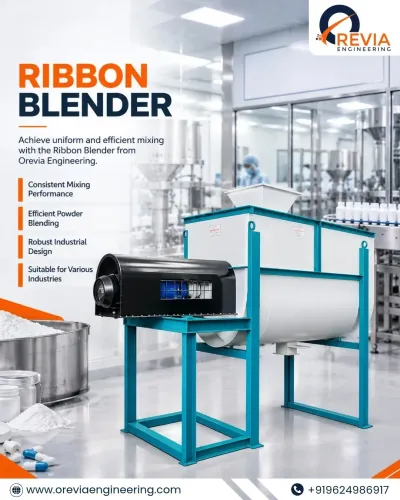
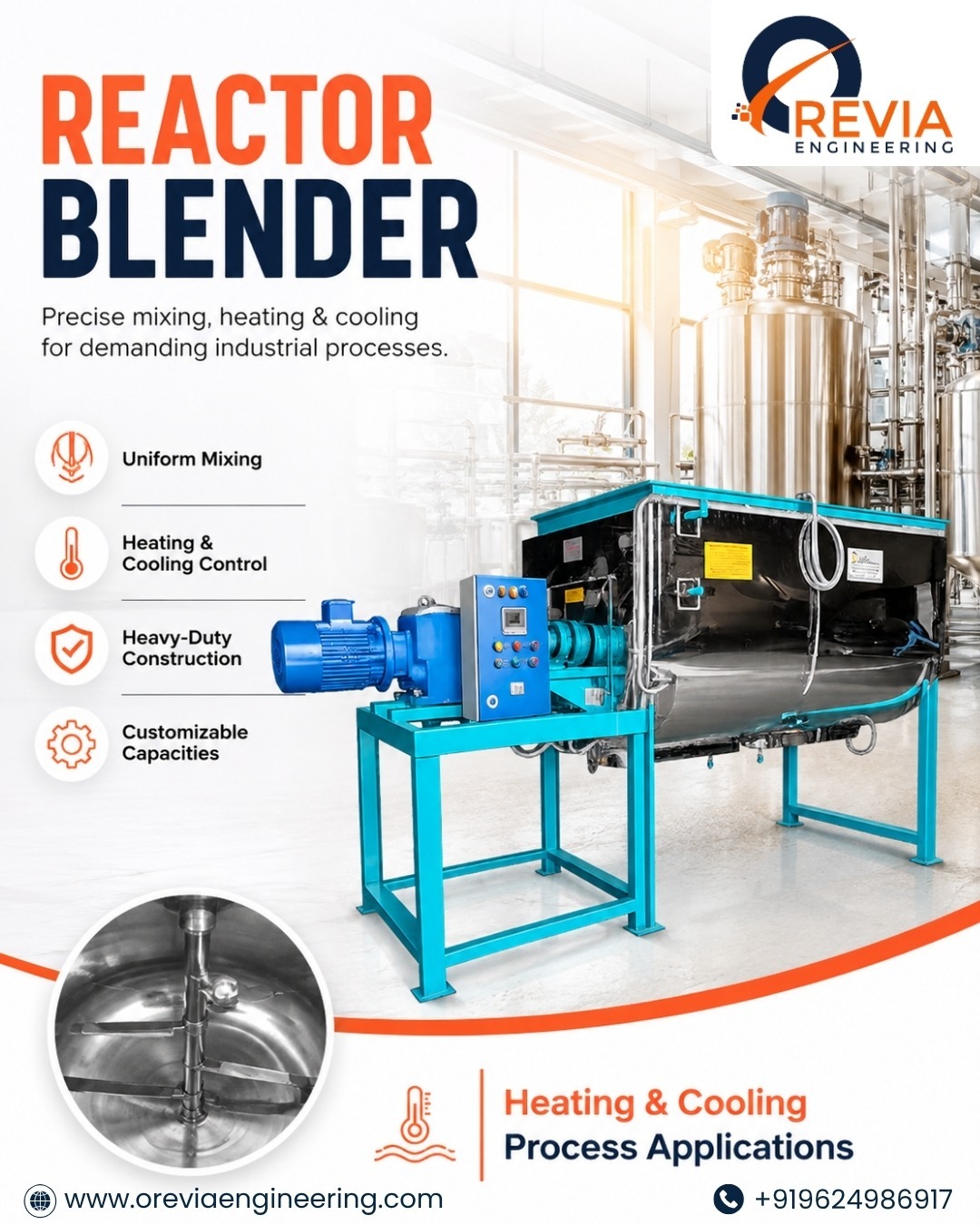
Modern industries require efficient equipment to mix materials uniformly while maintaining the right processing temperature. In many manufacturing processes, mixing and temperature control are essential to achieve consistent product quality. An Industrial Reactor Blender meets these requirements by combining material blending with heating and cooling.
A reactor blender supports controlled mixing, temperature management, and efficient batch processing. It can be used in industries where materials must be blended under specific processing conditions.
OREVIA Engineering offers Reactor Blender solutions designed around important industrial requirements, including uniform mixing, heating and cooling control, heavy-duty construction, and customizable capacities.
In this blog, we will explore what a reactor blender is, how it works, its key features, benefits, applications, and what to consider before choosing the right machine.
What Is a Reactor Blender?
A Reactor Blender is industrial processing equipment used to mix different materials inside a vessel while managing process conditions such as temperature and mixing speed.
Unlike a conventional mixer that mainly focuses on blending, a reactor blender can also incorporate heating and cooling arrangements. This makes it suitable for manufacturing processes that require controlled temperature conditions during mixing.
Depending on the machine design and configuration, a reactor blender may include:
* Industrial mixing vessel
* Motor-driven agitator or mixing blades
* Heating arrangement
* Cooling arrangement
* Temperature monitoring and control system
* Electrical control panel
* Heavy-duty supporting structure
* Customizable vessel capacity
These components help manufacturers manage different processing requirements and maintain consistent production conditions.
How Does a Reactor Blender Work?
A reactor blender combines mechanical mixing with temperature management. Its working process generally involves the following steps:
1. Raw Material Loading
Add the required raw materials to the mixing vessel according to the production formulation. The quantity and type of materials depend on the application and machine capacity.
2. Mixing and Blending
A motor drives the agitator or mixing blades inside the vessel. The movement helps distribute the materials throughout the mixture and supports uniform blending.
3. Heating Process
When the application requires heating, the heating arrangement raises the material temperature to the desired level. This can support processes such as dissolving, melting, or preparing materials for further processing.
4. Cooling Process
After heating or processing, the cooling arrangement helps reduce the material temperature. This is useful when a product needs to reach a specific temperature before discharge or the next production stage.
5. Product Discharge
Once the required mixing and temperature conditions are achieved, the processed material is discharged for further processing, packaging, or storage.
How Does a Reactor Blender Ensure Precise Mixing, Heating, and Cooling?
Maintaining consistent process conditions is important for industrial manufacturing. A reactor blender supports this through several key functions.
1. Uniform Mixing Performance
The agitator or mixing mechanism helps distribute materials throughout the vessel. Proper mixing supports consistent blending and reduces uneven material distribution.
2. Controlled Heating
The heating arrangement lets operators manage temperature according to process requirements. This is important for materials whose properties change with temperature.
3. Efficient Cooling
The cooling arrangement helps bring the material to the required temperature after processing. It supports temperature-sensitive manufacturing operations.
4. Heavy-Duty Construction
A strong supporting structure and suitable vessel construction help the machine withstand industrial operating conditions. Select the construction material based on the application and material compatibility requirements.
5. Customizable Capacity
Different manufacturing operations require different batch sizes. Customizable capacities help businesses choose a reactor blender based on their production volume and processing needs.
What Are the Key Features of a Reactor Blender?
Before selecting a reactor blender machine, it is important to understand the features that influence its operation and suitability.
* Uniform Mixing Mechanism: Supports consistent blending of materials inside the vessel.
* Heating and Cooling Control: Helps manage the required temperature during processing.
* Heavy-Duty Construction: Designed to support industrial operating requirements.
* Customizable Capacities: Allows selection according to production and batch requirements.
* Control Panel: Helps operators manage machine functions and operating adjustments.
* Industrial-Grade Vessel: Vessel material and design can be selected according to process conditions and material compatibility.
The availability and exact design of these features depend on the selected machine configuration.
What Are the Benefits of Using an Industrial Reactor Blender?
Investing in suitable industrial mixing equipment can improve manufacturing operations in several ways.
1. Improved Product Consistency
Uniform mixing and controlled processing conditions help manufacturers achieve more consistent batches.
2. Better Temperature Management
Heating and cooling arrangements help maintain the required processing temperature for different applications.
3. Improved Process Efficiency
Combining mixing and temperature management in one machine can simplify production workflows.
4. Reduced Manual Intervention
Depending on the automation and control configuration, operators can manage important machine functions more efficiently.
5. Flexible Production Requirements
Customizable capacities and machine configurations help businesses choose equipment that matches their production needs.
6. Reliable Industrial Operation
Suitable machine construction and regular maintenance support stable operation and dependable production.
Top 5 Reactor Blender Features to Compare Before Buying
If you are searching for the Top 5 Reactor Blender options for your manufacturing business, comparing important features can help you make a better purchasing decision.
Here are five important factors to evaluate:
1. Mixing Mechanism
Check the agitator design and mixing arrangement. The mechanism should suit the material type, viscosity, and required mixing performance.
2. Heating System
Evaluate the heating arrangement and the temperature range your manufacturing process requires. The heating method should match the application.
3. Cooling Arrangement
Check how the machine manages cooling and whether the arrangement can meet your required processing conditions.
4. Vessel Capacity and Construction
Choose a vessel capacity according to your batch size and production volume. Also check the construction material for compatibility with the materials being processed.
5. Control Panel and Customization
Evaluate the available operating controls, temperature monitoring features, and customization options. Select a configuration that matches your production requirements.
What Are the Industrial Applications of Reactor Blenders?
Reactor blenders can be used in industries that require controlled mixing and temperature management.
1. Chemical Industry
Used to blend chemical ingredients, prepare formulations, and process materials that require controlled temperature conditions.
2. Pharmaceutical Industry
Can support selected pharmaceutical processing applications, subject to suitable equipment design, hygiene requirements, and applicable standards.
3. Cosmetics Industry
May be used for processing creams, lotions, gels, and other cosmetic formulations when the machine configuration is suitable.
4. Paint and Coating Industry
Can support the mixing and preparation of selected paint, coating, and related formulations.
5. Specialty Chemical Manufacturing
Useful for batch processing where consistent blending and temperature management are important.
Note: Actual suitability depends on material properties, vessel construction, process conditions, and machine configuration.
How to Choose the Right Reactor Blender for Your Business?
Selecting the right reactor blender is an important decision for any manufacturing business. Consider these factors before purchasing.
1. Production Capacity: Determine your batch size and expected production volume.
2. Material Compatibility: Check whether the vessel and material-contact parts suit your raw materials.
3. Mixing Requirements: Select an appropriate mixing mechanism based on material viscosity and blending needs.
4. Heating Requirements: Confirm the required temperature range and heating method.
5. Cooling Requirements: Evaluate the cooling arrangement and required cooling time.
6. Machine Construction: Check the vessel material, supporting frame, and overall construction.
7. Operating Controls: Understand the control panel and available temperature monitoring features.
8. Customization: Discuss any special requirements related to capacity, design, or process conditions.
9. Maintenance Support: Ask about maintenance, spare parts, installation, and after-sales assistance.
Why Choose OREVIA Engineering for Reactor Blender Solutions?
Choosing the right industrial equipment manufacturer is essential to maintain production efficiency and consistent processing quality.
OREVIA Engineering offers Reactor Blender solutions focused on important industrial requirements, including:
* Uniform mixing performance
* Heating and cooling control
* Heavy-duty machine construction
* Customizable capacities
* Industrial process applications
The suitable machine configuration depends on your material characteristics, batch size, temperature requirements, and production process.
If you are looking for a Reactor Blender Manufacturer in Ahmedabad, connect with OREVIA Engineering to discuss your industrial mixing requirements and explore a suitable machine configuration.
Whether you are searching for a Reactor Blender Supplier in Gujarat or exploring a Reactor Blender Distributor in India, evaluate the manufacturer's product specifications, customization options, and technical support before buying.
Conclusion
A Reactor Blender is useful industrial equipment for manufacturing processes that require uniform mixing along with controlled heating and cooling. Its mixing mechanism, temperature-control systems, heavy-duty construction, and customizable capacity help businesses meet different production needs.
Before selecting a machine, consider its mixing performance, heating and cooling arrangements, vessel capacity, construction, and suitability for your materials.
Looking for a suitable Reactor Blender for your industrial application? Contact OREVIA Engineering to discuss your requirements and explore available solutions.
Frequently Asked Questions (FAQs)
1. What is a Reactor Blender used for?
It is used for mixing materials with controlled heating and cooling.
2. How does a Reactor Blender work?
It uses motor-driven agitators to mix materials inside a vessel.
3. Which industries use Reactor Blenders?
Chemical, pharmaceutical, cosmetic, paint, and coating industries.
Keywords