Industrial Sand Mill: Improve Grinding and Dispersion
An industrial sand mill machine improves material processing through several important mechanisms.
1. Fine Grinding Performance
The grinding media inside the chamber move as the agitator rotates. When these particles contact solid materials, they create mechanical forces that reduce particle size and break down agglomerates.
This fine grinding process helps manufacturers achieve the desired particle distribution for applications such as paints, inks, and industrial coatings.
2. Uniform Material Dispersion
Proper dispersion is essential when solid particles need to remain evenly distributed throughout a liquid. A sand mill grinding machine helps separate particle agglomerates and distribute the material more consistently.
Uniform dispersion can improve color development, surface finish, and product stability, depending on the formulation.
3. Improved Processing Efficiency
An appropriately designed industrial grinding mill can process materials with less manual intervention than many conventional batch-grinding approaches. The right operating conditions and equipment configuration can reduce unnecessary processing time.
Actual efficiency depends on the material's viscosity, initial particle size, grinding media, machine capacity, and target fineness.
4. Consistent Product Quality
Consistent grinding conditions help manufacturers achieve repeatable results across production batches. Factors such as agitator speed, temperature, flow rate, and residence time can influence the final product.
A properly operated sand mill for industrial applications can support quality control by helping manufacturers maintain the required particle size and dispersion characteristics.
What Are the Main Applications of an Industrial Sand Mill
An industrial sand mill is used in several industries that require fine grinding and effective dispersion.
* Paints and coatings: Disperses pigments and improves color uniformity.
* Printing inks: Supports fine pigment dispersion for consistent printing performance.
* Pigment manufacturing: Reduces agglomerates and helps achieve the required particle distribution.
* Chemical processing: Processes compatible solid-liquid formulations that require fine grinding.
* Dyes and colorants: Helps distribute coloring materials throughout a liquid medium.
* Specialty formulations: Can be used in selected products where particle size and dispersion influence performance.
The appropriate machine design depends on the material's chemical properties, viscosity, abrasiveness, and processing requirements.
What Features Should You Look for in a Sand Mill Machine
Choosing the right sand mill machine involves more than comparing purchase prices. Businesses should evaluate equipment specifications and whether they suit the intended application.
Grinding Chamber Design
The chamber should suit the material being processed and the required production capacity. Its design influences grinding performance, heat management, and cleaning requirements.
Agitator Performance
The agitator provides movement to the grinding media. Its design and operating speed affect the energy transferred to the material and the resulting grinding performance.
Grinding Media Compatibility
Grinding media vary in size, density, hardness, and composition. Selecting suitable media helps achieve the required fineness while managing wear and contamination risks.
Temperature Control
Grinding can generate heat, which may affect temperature-sensitive formulations. Depending on the application, cooling arrangements can help maintain suitable processing conditions.
Maintenance and Cleaning
Accessible components, appropriate seals, and practical cleaning arrangements can simplify maintenance and reduce production interruptions.
Production Capacity
The equipment should match the required throughput, batch size, material viscosity, and desired product quality. Confirm the manufacturer's rated capacity and the conditions under which it applies.
How to Choose the Right Industrial Sand Mill
Before purchasing an industrial sand mill, consider the following factors:
* Material type: Identify whether the machine will process paint, ink, pigments, coatings, or another formulation.
* Required particle size: Establish the target fineness and acceptable particle-size distribution.
* Production volume: Match the machine capacity to your daily or batch production needs.
* Material viscosity: Confirm that the equipment can handle the formulation's flow characteristics.
* Cooling requirements: Determine whether the material needs temperature control during grinding.
* Energy consumption: Review motor power and expected operating requirements.
* After-sales support: Evaluate spare-parts availability, technical assistance, and maintenance services.
Discussing these factors with a manufacturer can help you identify a machine that meets your production and quality objectives.
Why Consider Orevia Engineering for Sand Mill Solutions
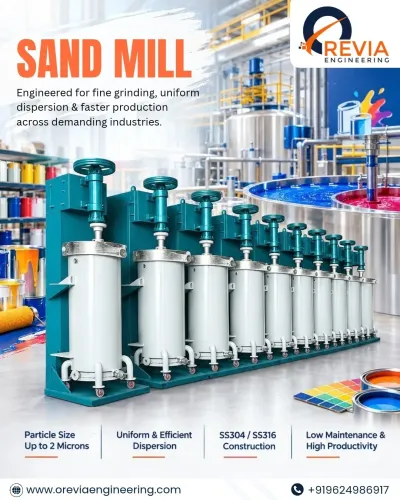
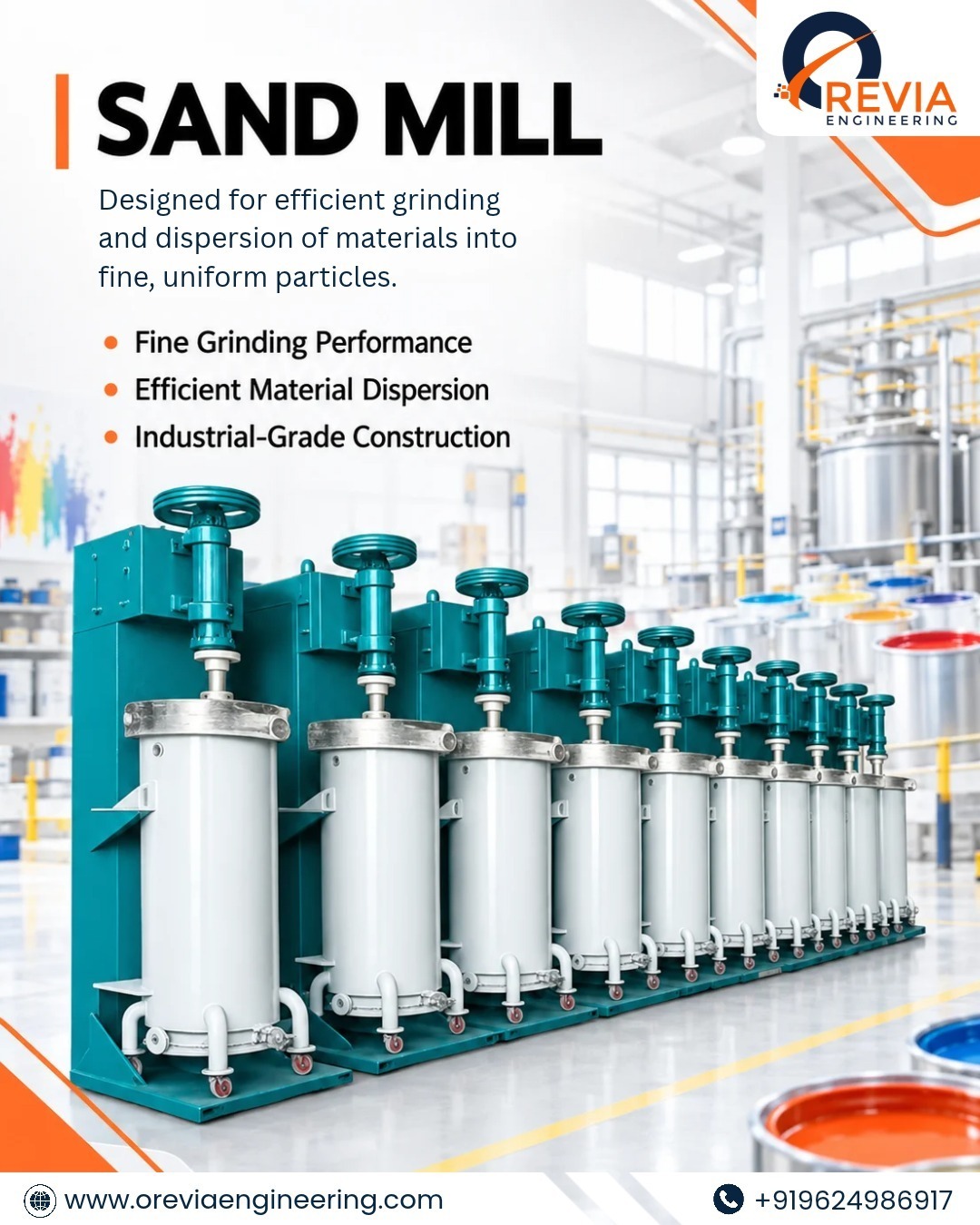
Orevia Engineering Pvt. Ltd. is the company name presented in the product reference, which features sand mill equipment designed for fine grinding and material dispersion. Businesses evaluating sand mill machinery can use their application requirements to determine the appropriate equipment configuration.
Before selecting a machine, confirm the available models, technical specifications, grinding capacity, compatible materials, and service support directly with the supplier.
Choosing equipment based on actual processing needs helps manufacturers make a more informed investment and maintain consistent production standards.
An industrial sand mill improves grinding and material dispersion by using mechanical forces to break down particle agglomerates and distribute solid materials throughout a liquid medium. This makes the equipment useful for manufacturing paints, coatings, inks, pigments, and other compatible formulations.
Factors such as grinding media, agitator design, temperature control, material viscosity, and machine capacity all influence performance. By carefully evaluating these requirements, manufacturers can select a sand mill that fits their production process.
Looking for a suitable sand mill for your application? Contact Orevia Engineering to discuss your material, required particle fineness, and production capacity before choosing an appropriate solution.
Frequently Asked Questions (FAQs)
1. What is an industrial sand mill used for?
An industrial sand mill grinds solid particles and disperses them evenly in a liquid. Common applications include paint, ink, pigment, coating, and chemical manufacturing.
2. How does a sand mill machine work?
A motor rotates an agitator inside a grinding chamber containing grinding media. The resulting impact and shear forces reduce particle agglomerates and improve material dispersion.
3. What is the difference between grinding and dispersion?
Grinding reduces particle size or breaks apart agglomerates. Dispersion distributes particles more evenly throughout a liquid medium. A sand mill can perform both functions during processing.
Keywords