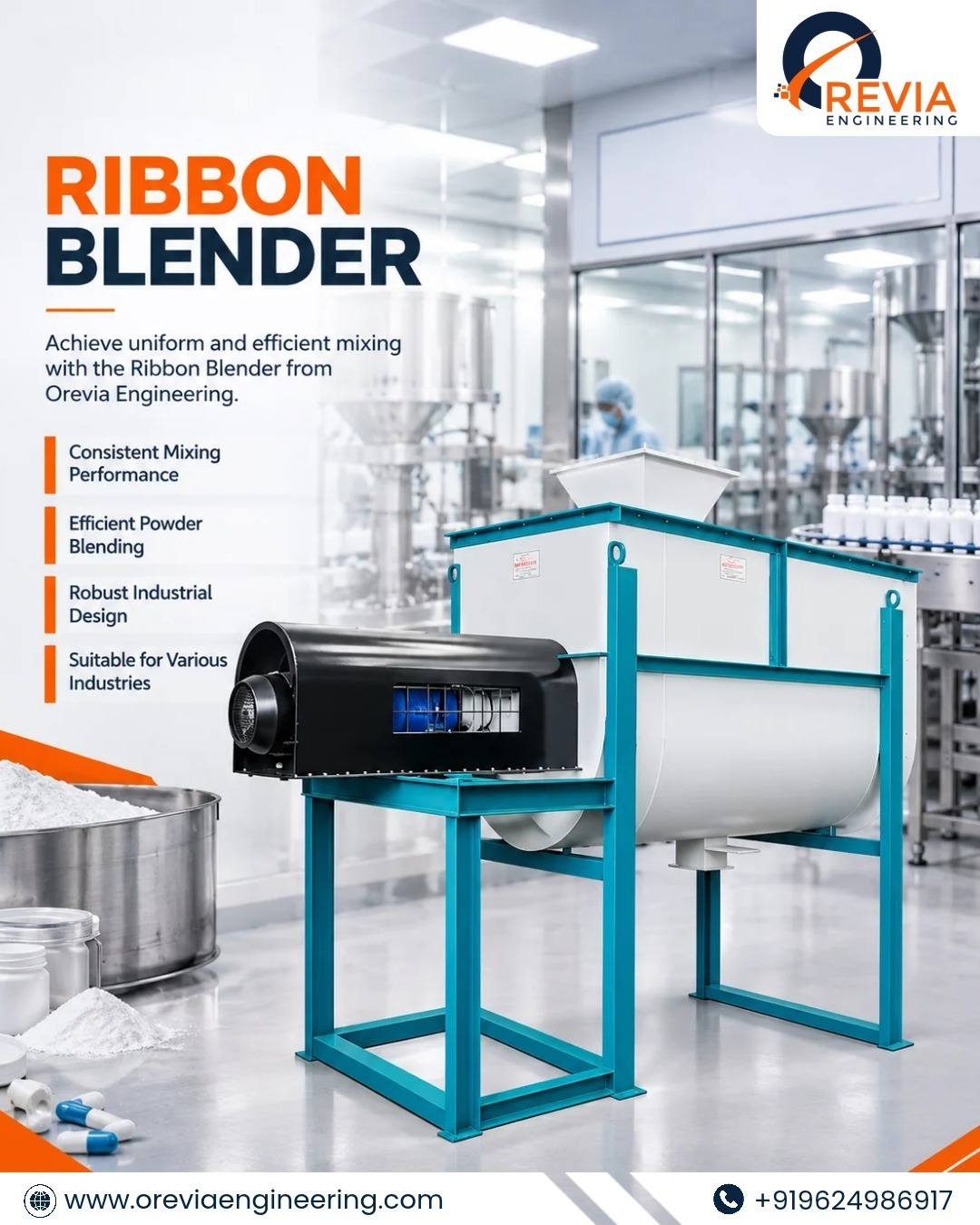
Achieving a uniform mixture is essential for manufacturers working with dry powders, granules, and other compatible materials. A Ribbon Blender Machine helps combine ingredients through controlled material movement, supporting consistent product quality and efficient batch processing. It is widely used in industries where accurate ingredient distribution and dependable mixing performance are important.
Orevia Engineering Pvt. Ltd. offers industrial engineering solutions for a range of processing requirements. Selecting the right ribbon blender involves evaluating material properties, batch capacity, mixing requirements, and equipment design to achieve the desired results.
What Is a Ribbon Blender Machine?
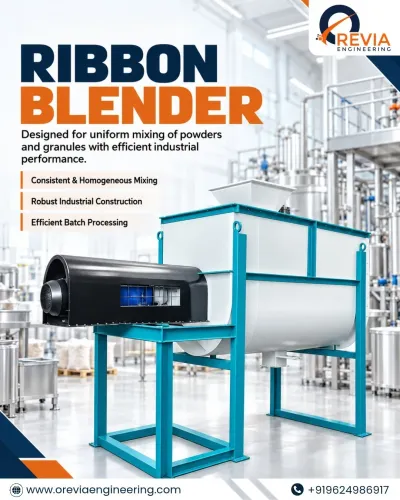
A ribbon blender is an industrial mixing machine that blends dry powders and granules in a horizontal trough. It typically consists of a mixing chamber, central shaft, helical ribbons, drive assembly, and discharge arrangement.
As the shaft rotates, the inner and outer ribbons move material in opposite directions. This creates circulation within the chamber and helps distribute ingredients throughout the batch.
Businesses looking for a Ribbon Blender Machine Manufacturer in Ahmedabad should consider how the machine's design matches their production needs, material characteristics, and required blend uniformity.
How Does a Ribbon Blender Machine Improve Mixing Efficiency?
A properly selected ribbon blender can support efficient production by improving material movement and helping manufacturers maintain repeatable mixing conditions.
1. Promotes Uniform Powder Mixing
The inner and outer ribbons move material along different paths within the trough. This movement helps distribute ingredients throughout the batch and reduces the risk of uneven concentrations.
Uniform blending is particularly important when products require consistent color, composition, texture, or ingredient distribution.
2. Supports Efficient Batch Production
Ribbon blenders process a measured quantity of material during each mixing cycle. Choosing the right working capacity and operating time helps manufacturers meet production targets without unnecessarily extending processing cycles.
Actual mixing time depends on the formulation, batch size, particle characteristics, and required level of uniformity.
3. Handles Different Powder and Granule Types
An industrial ribbon blender can process various compatible dry materials, depending on its construction and configuration. Common applications include chemical powders, food ingredients, pharmaceutical excipients, fertilizer blends, and plastic additives.
Before choosing equipment, manufacturers should assess particle size, bulk density, flowability, abrasiveness, and material compatibility.
4. Helps Maintain Consistent Product Quality
Consistent loading, appropriate shaft speed, and controlled mixing time support repeatable results. Maintaining these parameters helps manufacturers achieve similar blending characteristics across production batches.
For formulations that require precise ingredient distribution, mixing trials and quality testing can help establish suitable operating conditions.
5. Supports Cleaning and Routine Maintenance
Equipment accessibility and construction influence cleaning and maintenance requirements. Smooth product-contact surfaces, good access points, and an appropriate discharge design can make routine upkeep easier.
Manufacturers handling multiple formulations should also evaluate cleaning procedures and measures to prevent cross-contamination.
Important Features to Consider When Selecting a Ribbon Blender
When purchasing a Ribbon Blender Machine, evaluate the following factors to determine whether the equipment suits your operation.
Mixing Capacity
Choose a machine based on your required batch volume, production schedule, and material bulk density. Follow the manufacturer's recommended filling limits to support effective material circulation.
Construction Material
The construction material should be compatible with the ingredients and operating environment. Stainless steel may suit applications that require corrosion resistance or meet specific hygiene standards.
Ribbon Design and Mixing Performance
Ribbon geometry, shaft speed, and trough dimensions affect how materials circulate inside the chamber. The selected design should match the material properties and desired blending results.
Discharge Arrangement
The discharge mechanism influences how efficiently the finished blend moves to the next production stage. Consider outlet size, material retention, discharge time, and compatibility with downstream equipment.
Safety and Maintenance Requirements
Review machine guards, emergency stops, access covers, maintenance needs, and spare-part availability. Applications involving food, pharmaceuticals, or hazardous materials may require additional design and compliance considerations.
Applications of Ribbon Blender Machines Across Industries
Ribbon blenders are used in manufacturing environments where compatible dry ingredients must be mixed consistently.
* Chemical manufacturing: Blending powdered chemicals, additives, and selected formulations.
* Food processing: Mixing spices, seasoning powders, flour blends, and other suitable dry ingredients.
* Pharmaceutical production: Blending compatible powders and excipients under appropriate process controls.
* Plastic manufacturing: Combining pigments, additives, and selected dry materials.
* Fertilizer production: Mixing powdered and granular fertilizer ingredients.
* Cosmetics manufacturing: Blending suitable dry ingredients for cosmetic formulations.
A ribbon blender's suitability depends on the specific material, required mixing quality, cleaning needs, and applicable industry standards.
How to Choose the Right Ribbon Blender Machine Supplier
Selecting suitable equipment involves more than comparing machine prices. Manufacturers should evaluate the supplier's ability to understand their process requirements and provide relevant technical information.
If you are considering a Ribbon Blender Machine Supplier in Gujarat, assess these points before making a decision:
* Capacity requirements: Confirm that the machine can handle your expected batch volume.
* Material compatibility: Check whether the construction and design suit the materials being processed.
* Mixing performance: Ask about ribbon configuration, operating parameters, and blend uniformity.
* Customization options: Determine whether the equipment can accommodate your production layout and process requirements.
* Maintenance support: Discuss routine servicing, spare parts, and technical assistance.
* Operating costs: Consider power consumption, cleaning time, maintenance, and production efficiency alongside the initial purchase price.
Understanding these factors helps businesses compare equipment options more effectively.
Why Consider Orevia Engineering Pvt. Ltd.?
When evaluating industrial mixing equipment, choose a solution that aligns with your material characteristics, production volume, and operational requirements.
Contact Orevia Engineering Pvt. Ltd. to discuss ribbon blender requirements and identify the specifications for your application. Before finalizing a machine, clarify its capacity, construction, operating conditions, cleaning requirements, and available technical support.
Businesses searching for a Ribbon Blender Machine Manufacturer in Ahmedabad, a Ribbon Blender Machine Supplier in Gujarat, or a Ribbon Blender Machine Distributor in India should compare relevant product specifications and service arrangements to find equipment that meets their needs.
A Ribbon Blender Machine can improve powder mixing efficiency by promoting material circulation, supporting uniform ingredient distribution, and enabling controlled batch processing. Its performance depends on ribbon design, batch loading, material properties, and operating conditions.
By selecting suitable equipment and following consistent operating and maintenance practices, manufacturers can improve batch quality and support reliable production. Contact Orevia Engineering Pvt. Ltd. to discuss your mixing requirements and explore the right configuration for your application.
Frequently Asked Questions (FAQs)
1. What is a Ribbon Blender Machine used for?
A ribbon blender mixes dry powders, granules, and other compatible solid materials. It is commonly used in chemical, food, pharmaceutical, plastic, and fertilizer manufacturing.
2. How does a ribbon blender achieve uniform mixing?
Its inner and outer helical ribbons move materials in different directions within the mixing trough. This circulation helps distribute ingredients throughout the batch.
3. Which factors affect ribbon blender performance?
Performance depends on batch capacity, ribbon design, shaft speed, mixing duration, particle size, bulk density, material flow characteristics, and the required level of uniformity.
Keywords