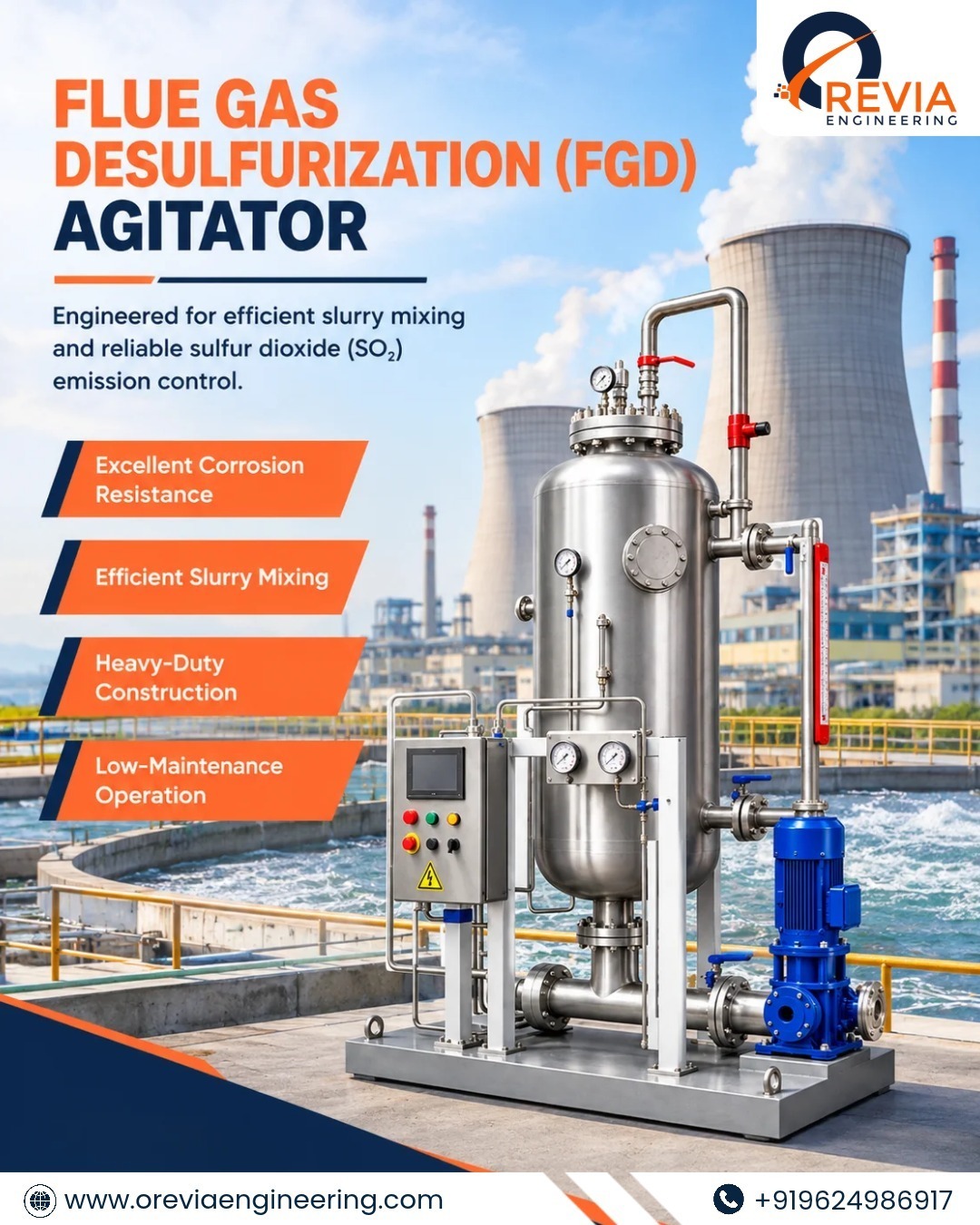
Industrial plants need effective emission control systems to reduce harmful gases released during manufacturing and power generation. A Flue Gas Desulfurization (FGD) Agitator plays a key role in wet scrubber systems by maintaining uniform slurry mixing, preventing solids from settling, and supporting sulfur dioxide (SO₂) absorption.
Proper agitation maintains consistent slurry conditions and improves overall desulfurization performance. With proper construction, corrosion resistance, and mixing performance, an FGD agitator can operate reliably in demanding industrial environments.
What Is a Flue Gas Desulfurization (FGD) Agitator?
A Flue Gas Desulfurization (FGD) Agitator is specialized industrial mixing equipment used in wet desulfurization systems. It circulates limestone or lime slurry in reaction tanks and keeps suspended solids evenly distributed throughout the mixture.
During wet scrubbing, flue gas contacts an alkaline slurry that absorbs sulfur dioxide. The agitator maintains proper slurry movement, helping ensure that reactive materials remain available throughout the process.
How Does an FGD Agitator Improve Slurry Mixing and Sulfur Dioxide Removal?
A properly selected FGD agitator supports efficient desulfurization through several key functions.
1. Maintains Consistent Slurry Distribution
The agitator generates controlled movement within the tank, helping distribute limestone particles and liquid components evenly. Uniform slurry distribution supports stable operating conditions and improves the availability of reactive material.
2. Reduces Sediment Accumulation
Solid particles can settle at the bottom of tanks when mixing is insufficient. An effective Industrial FGD Agitator keeps suspended particles moving and helps minimize sediment formation, reducing potential operational problems.
3. Supports Effective Sulfur Dioxide Absorption
Proper slurry circulation helps maintain consistent contact between the alkaline liquid and incoming flue gas. This supports sulfur dioxide absorption and contributes to the wet desulfurization system's performance.
4. Improves Mixing Efficiency
Suitable impeller design and agitator speed help create the required circulation pattern inside the tank. Effective mixing supports uniform slurry composition and helps maintain predictable process conditions.
5. Supports Reliable Industrial Operation
FGD systems often handle abrasive particles and chemically aggressive mixtures. Equipment designed with suitable materials, strong construction, and reliable mechanical components can withstand demanding operating conditions.
Important Features of an Efficient FGD Agitator
When selecting a Flue Gas Desulfurization Agitator, industries should evaluate the following features:
* Corrosion Resistance: Choosing the right material helps protect equipment from chemically aggressive slurry.
* Efficient Slurry Mixing: Proper impeller design supports uniform circulation and solid suspension.
* Heavy-Duty Construction: A robust structure helps withstand continuous industrial operating conditions.
* Reliable Mechanical Components: Quality shafts, bearings, seals, and drive arrangements support dependable performance.
* Maintenance-Friendly Design: Accessible components make routine inspection and servicing more convenient.
* Process Compatibility: The agitator should match the tank dimensions, slurry properties, and required mixing performance.
Industrial Applications of Flue Gas Desulfurization Agitators
A Flue Gas Desulfurization (FGD) Agitator is used in industrial facilities that require wet gas treatment and control of sulfur dioxide emissions.
Common applications include:
* Thermal Power Plants: Maintains limestone slurry circulation in wet scrubber systems.
* Cement Manufacturing Units: Supports suitable flue gas treatment processes for emission control.
* Chemical Processing Plants: Helps maintain uniform mixtures in compatible gas treatment applications.
* Steel and Metal Industries: Supports wet desulfurization processes used for industrial exhaust treatment.
* Industrial Scrubber Systems: Maintains slurry suspension inside reaction and storage tanks.
Factors to Consider When Choosing an FGD Agitator
Selecting the right FGD Slurry Mixing Agitator requires careful evaluation of process and installation requirements.
Consider these important factors:
* Tank Dimensions: Check the tank diameter, depth, and internal configuration.
* Slurry Characteristics: Evaluate viscosity, density, solid concentration, and particle size.
* Material Selection: Choose materials suitable for the slurry's chemical and abrasive properties.
* Impeller Design: Consider the circulation pattern and suspension requirements.
* Motor Capacity: Select an appropriate motor and drive arrangement according to the mixing load.
* Maintenance Support: Evaluate component accessibility, spare-part availability, and servicing requirements.
Selecting a suitable agitator helps maintain mixing consistency, minimize operating difficulties, and support long-term equipment performance.
Choose Orevia Engineering Pvt. Ltd. for Flue Gas Desulfurization (FGD) Agitators
Orevia Engineering Pvt. Ltd. focuses on industrial engineering solutions for demanding process applications. Selecting the right Flue Gas Desulfurization (FGD) Agitator is essential to maintain slurry circulation, reduce sediment buildup, and support effective sulfur dioxide emission control.
If you are looking for a Flue Gas Desulfurization (FGD) Agitator Manufacturer in Ahmedabad, a Flue Gas Desulfurization (FGD) Agitator Supplier in Gujarat, or a Flue Gas Desulfurization (FGD) Agitator Distributor in India, contact Orevia Engineering Pvt. Ltd. to discuss your equipment requirements.
Contact the company to explore agitator solutions suited to your tank configuration, slurry properties, material requirements, and industrial application.
Frequently Asked Questions (FAQs)
1. What is the primary purpose of a Flue Gas Desulfurization (FGD) Agitator?
Its primary purpose is to maintain uniform slurry mixing, keep solid particles suspended, and minimize sediment accumulation inside desulfurization tanks.
2. How does an FGD Agitator support sulfur dioxide removal?
It maintains proper slurry circulation, helping the alkaline liquid maintain contact with sulfur dioxide in the flue gas. This supports the absorption process in wet desulfurization systems.
3. Why is corrosion resistance important in an FGD Agitator?
FGD systems often handle chemically aggressive and abrasive slurry. Suitable corrosion-resistant materials help protect equipment components and support longer service life.
Keywords